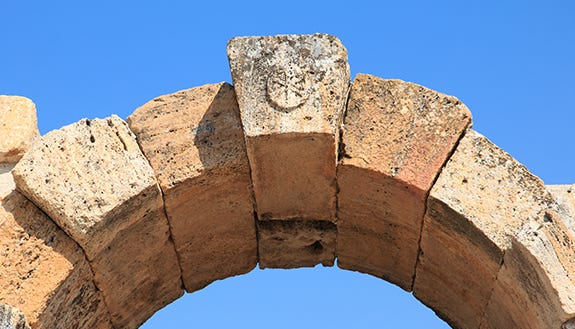
The Keystone Era
A "Sunday Reflections" Series

Lately, I’ve been thinking about keystones. A keystone is the central stone in an arch. It’s not the largest stone, nor the strongest. In fact, if you looked at the structure casually, you might not even notice it. Yet without it, the arch collapses.

What fascinates me is that the keystone doesn’t remove tension. The arch exists because of tension. The keystone simply allows opposing forces to become part of a coherent whole.

For a while, I thought the lesson was about embodying the energy of a keystone. Now I’m certain, it’s about relational awareness. Or perhaps more accurately, it’s an energy that becomes visible when people come together in the right way.

Recently, I've been describing partners as co-creators. The idea that when two people meet, something becomes possible that neither could have accomplished alone. But lately I’ve been wondering if even that language misses something.

What if we’re not creating the keystone at all? What if we’re recognizing it?

What if certain relationships, collaborations, and conversations reveal a deeper architecture that was always there, waiting to be seen?

I’ve experienced this with people whose perspectives differ from my own. People with different backgrounds, beliefs, experiences, and strengths. On paper, we shouldn’t fit. And yet something extraordinary happens when neither person is trying to convince, fix, rescue, or change the other. A larger picture comes into view. Not because we become the same. But because we remain different.

The keystone doesn’t erase the stones on either side of the arch. It allows them to belong to the same structure. Perhaps that is what I’ve been trying to describe when I speak about WE.

Not the loss of individuality.
Not agreement.
Not sameness.

But the recognition that there are dimensions of reality we cannot access alone.

Some truths only become visible through relationship.
Some patterns only emerge through participation.
Some forms of coherence can only be recognized when different pieces of the puzzle find one another.

Maybe this is the invitation of the Keystone Era. To spend less time asking, “What can I build?” And more time asking: “What becomes visible when we come together?”

Because perhaps the most important thing we create isn’t something new at all.
Perhaps it’s our ability to recognize the hidden architecture that has been waiting between us all along.